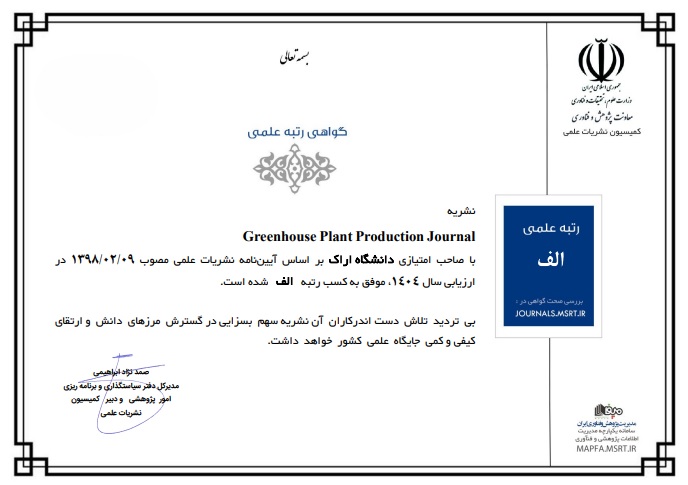
gppj-rank

Journal Metrics
 Number of Volumes      3
 Number of Issues      10
 Number of Articles      61
 Time to Accept (Days)      27
 Number of Reviewers      146
 Article View     33,843
 PDF Download     25,050


Scientific Rank (Iran Ministry of Science, Research, and Technology): B


Greenhouse Plant Production Journal (GPPJ) is an international, peer-reviewed, open access journal publishing research related to horticultural crops. Articles in the journal deal with protected production of vegetablesfruitsornamentals and medicinal plants. Papers in related areas (plant physiology, plant nutrition, biochemistry, micropropagation, soil science, plant breeding, phytopathology, etc.) are considered, if they contain information of direct significance to protected horticulture. Basic molecular studies without any direct application in protected horticulture will not be considered for this journal.

  • Types of paper:
    1. Original full papers (regular papers)
    2. Review articles (should cover a part of the subject of active current interest)

    Original papers should report the results of original research and should be of international and not only regional interest. The material should not have been previously published elsewhere. Reviews should cover a part of the subject active current interest. They may be submitted or invited.

Publisher: Arak University

Language: English

Frequency: Quarterly 

Journal format: Electronic

Review Time: 4-8 Weeks (In average)

The type of arbitration: Double Blind Peer Review

The cost of reviewing, judging, accepting and publishing : Free

Access to the articles of this site and downloading the articles from this journal: Free   

Creative Commons License  This journal is licensed under a Creative Commons Attribution-NonCommercial 4.0 International License.

This journal is following of Committee on Publication Ethics (COPE) and complies with the highest ethical standards in accordance with ethical laws.

To prevent plagiarism, articles received through the Ithenticate are identified.


Influence of Salicylic Acid Concentrations and Spraying Times on Growth and Physiology of Eggplant

Influence of Salicylic Acid Concentrations and Spraying Times on Growth and Physiology of Eggplant

Pages 1-17

https://doi.org/10.66224/gppj.3.2.1

Seyed Mohammad Javad Arvin, Ehsan Salari, Hamid Reza Soufi

Abstract Salicylic acid (SA) is a key signaling molecule that regulates plant growth, flowering, and responses to abiotic and biotic stresses. This study evaluated the effects of different SA concentrations (0, 0.5, and 1.0 mM) and application frequencies (once and twice) on the growth, pigment composition, and yield of eggplant (Solanum melongena L.) under field conditions during the 2023–2024 growing season. Eggplant seeds were sown in a cocopeat and perlite growing medium at a ratio of 3:1 and the seedlings were watered daily in greenhouse. Foliar spraying was done in two stages before transplanting (four-leaf stage) in greenhouse and before flowering in farm. After the first foliar spray, the eggplant seeds were transferred to the field and the plants were irrigated every three days throughout the growth period. A factorial experiment arranged in a completely randomized design revealed significant SA effects on most measured traits, with 0.5 mM producing the most favorable outcomes. Compared with the control, this treatment increased relative water content by 11%, reduced electrolyte leakage by 30–35%, and enhanced SPAD values, total chlorophyll, and carotenoid contents by up to 120%. Plant height, fruit number, and total yield rose by 38.1%, 85.7%, and 88.6%, respectively. Two applications further improved growth and yield compared to a single spray, indicating that repeated applications amplify the physiological benefits of SA. In contrast, 1.0 mM SA provided no additional improvement, suggesting a threshold beyond which inhibitory effects are not observed. The observed enhancements were associated with improved water balance, enhanced photosynthetic efficiency, and increased membrane integrity. Overall, applying 0.5 mM SA twice during both the vegetative and reproductive stages proved to be an optimal, low-cost, and environmentally safe strategy for enhancing eggplant growth and productivity. Future studies should elucidate SA’s molecular mechanisms and interactions with other biostimulants and stresses to optimize its use across crops and production systems.

Unlocking the Potential of Heirloom Tomatoes as Rootstocks for Sustainable Greenhouse Tomato Production

Unlocking the Potential of Heirloom Tomatoes as Rootstocks for Sustainable Greenhouse Tomato Production

Pages 18-30

https://doi.org/10.66224/gppj.3.2.18

Hamdieh Eini Garsadafi, Sadegh Mousavi-Fard, Bahman Zahedi, Abdolhossein Rezaei Nejad

Abstract Heirloom tomatoes (Solanum lycopersicum L.) are highly valued for their superior quality, yet their potential as rootstocks remains largely unexplored. The experiment followed a 4×2factorial arrangement consisting of four rootstock levels (the commercial hybrid ‘Parisa’, two heirloom rootstocks, and a non-grafted control) and two scion cultivars (‘Sylviana’ and ‘E15B.50115’). Under this design, grafting success, vegetative vigor, yield, and fruit quality were assessed. The commercial rootstock ‘Parisa’ maximized total yield, reaching 1316.93 g/plant, while the Heirloom1 rootstock achieved a competitive marketable fruit percentage of 84.28%, comparable to the commercial hybrid. Beyond these primary yield components, heirloom rootstocks significantly improved fruit quality attributes compared to non-grafted controls, specifically increasing fruit firmness, titratable acidity (up to 4.12 mL), and total soluble solids (up to 4.87 °Brix), as well as enhancing morphometric traits such as larger fruit diameter (6.31 cm) and increased pericarp thickness. These reproductive and quality benefits were supported by enhanced vegetative vigor, with Heirloom1 producing the tallest plants (279.67 cm) and the highest root dry weight (13.72 g). Consequently, these findings demonstrate that while commercial rootstocks excel in total biomass production, heirloom rootstocks provide a superior strategy for optimizing marketable quality and physiological performance in greenhouse production. These findings demonstrate that locally adapted heirloom genotypes are valuable, under-utilized genetic resources. Their use as rootstocks offers a strategy to improve plant vigor, fruit quality, and sustainability in high-value greenhouse tomato production systems.

Feasibility of Raspberry (Rubus idaeus L.) Cultivar Cultivation under Greenhouse Conditions

Feasibility of Raspberry (Rubus idaeus L.) Cultivar Cultivation under Greenhouse Conditions

Pages 31-40

https://doi.org/10.66224/gppj.3.2.31

Fatemeh Haghparast, Jamal-Ali Olfati, Moazzam Hassanpour, Mahmood Ghasemnezhad, Davood Bakhshi

Abstract This study was conducted to evaluate the performance of four red raspberry cultivars, namely ‘Encore’, ‘Rosana’, ‘Polana’, and ‘Saanich’, under hydroponic cultivation in a greenhouse. Two-year-old plants were grown in 12-L pots containing a raspberry-specific substrate, using an open drip hydroponic system. The substrate consisted of 40–45% processed wood fiber, 20–25% processed pine bark fiber, 25–30% processed pumice, 1–2% hardening agent, and 0.5–1% wetting agent. Plants were fertigated with a standard nutrient solution formulated for raspberry production. ‘Encore’ exhibited superior vegetative growth, recording the highest plant height (142 cm), stem diameter (7.24 mm), internode length (3.25 cm), and number of suckers per plant (3.5), while ‘Rosana’ had the highest leaf number (38). ‘Encore’ significantly outperformed the other cultivars, with the highest number of fruits per plant (31), fruits per inflorescence (6), inflorescences per plant (5.25), fruit weight (1.4 g), and receptacle diameter (15.35 mm). ‘Polana’ flowered and fruited earlier than the other cultivars, whereas ‘Encore’ required a longer period to flowering and harvest. The highest TSS was recorded in ‘Polana’ (8.87). The highest total phenolic content among the evaluated cultivars was found in ‘Saanich’ (55.45) and ‘Polana’ (53.85), while the highest anthocyanin content was observed in ‘Rosana’ (30.83). The highest vitamin C content was recorded in ‘Encore’ and ‘Polana’ (11.66). ‘Polana’ showed earlier flowering and favorable biochemical characteristics, ‘Encore’ demonstrated the best vegetative growth and yield performance. Therefore, ‘Encore’ can be recommended as the most suitable cultivar for hydroponic greenhouse raspberry production.

Evaluation of the Allelopathic Potential of Thymus kotschyanus Boiss. Extracts on Seed Germination, Growth, and Photosynthetic Activity of Convolvulus arvensis L. and Cynodon dactylon L.

Evaluation of the Allelopathic Potential of Thymus kotschyanus Boiss. Extracts on Seed Germination, Growth, and Photosynthetic Activity of Convolvulus arvensis L. and Cynodon dactylon L.

Pages 41-50

https://doi.org/10.66224/gppj.3.2.41

Reza Rezvani, Abbas Biabani

Abstract This study investigated the allelopathic potential of Thymus kotschyanus Boiss. on the germination, growth, and photosynthetic performance of Cynodon dactylon and Convolvulus arvensis. Laboratory and greenhouse experiments were conducted in 2025 using a completely randomized design with four replications at a research farm in Shirvan, North Khorasan Province, Iran. Treatments consisted of aqueous root and shoot extracts of mountain thyme prepared by soaking plant material in distilled water and shaking for 24 h at room temperature under continuous agitation (200 rpm), at concentrations of 10 and 20 g L-1, with distilled water serving as the control. The results indicated that the highest extract concentration (20 g L-1) significantly reduced germination percentage in C. dactylon by 19.8% and 36.6% and in C. arvensis by 31.2% and 51.3% following application of shoot and root extracts, respectively, compared with the control. Under the same treatment conditions, germination rate decreased by 36.8% and 57.8% in C. dactylon and by 44.2% and 65.0% in C. arvensis, respectively. Application of the root extract at 20 g L-1 significantly reduced several growth and physiological traits in both weed species, including plant height (34.4% and 31.7%), leaf area (41.8% and 43.0%), shoot dry weight (29.4% and 34.9%), total chlorophyll content (30.4% and 36.0%), net photosynthetic rate (41.0% and 50.4%), and stomatal conductance (50.5% and 56.6%) in C. dactylon and C. arvensis, respectively (P ≤ 0.01). Overall, the findings demonstrated that root and shoot extracts of T. kotschyanus, likely containing water-soluble allelochemicals, markedly inhibited germination and growth of both weed species. These results suggest that T. kotschyanus may have potential for future development of bioherbicidal agents and could serve as a promising candidate for environmentally friendly weed management strategies.

Evaluation of Rooting Media, Cultivars and Mycorrhizal Fungi on Some Rooting Traits of Olea europaea L. Cuttings

Evaluation of Rooting Media, Cultivars and Mycorrhizal Fungi on Some Rooting Traits of Olea europaea L. Cuttings

Pages 51-61

https://doi.org/10.66224/gppj.3.2.51

Fatemeh Bidarnamani, zeinab mohkami, mohammad forouzandeh, Ehsan Elahi-Moghaddam

Abstract Low and inconsistent rooting remains a major constraint to the vegetative propagation of Olea europaea L., owing to genotype-dependent rooting capacity and the influence of rooting substrate and beneficial micro-organisms. Therefore, this study evaluated the interactive effects of rooting substrate (perlite, cocopeat, perlite+ cocopeat), olive cultivar (Zard, Koroneiki, Roghani), and arbuscular mycorrhizal fungi (control, G. intraradices, G. mossaea, G. intraradices+ G. mossaea) on the rooting performance of olive stem cuttings under greenhouse conditions using a factorial experiment in a completely randomized design with three replications in Research Institute of Zabol on 2025. The results demonstrated that rooting performance was strongly influenced by the combined effects of cultivar, substrate, and mycorrhizal inoculation. Inoculation with Glomus intraradices consistently enhanced callus formation, rooting percentage, and the number of roots per cutting compared with the non-inoculated treatment suggesting that arbuscular mycorrhizal symbiosis promoted adventitious root formation through improved mineral nutrition, enhanced water relations, and increased root growth potential. Cocopeat promoted the highest callus formation, whereas perlite produced the greatest number of roots, indicating superior root development. Rooting responses also varied among cultivars, with the Zard cultivar exhibiting the highest root production, particularly when grown in perlite. The highest rooting percentage was achieved in the cocopeat–perlite substrate inoculated with G. intraradices. These findings demonstrate that integrating an appropriate rooting substrate with arbuscular mycorrhizal inoculation can substantially improve the vegetative propagation of olive, providing an effective strategy for producing high-quality nursery plants.

Stress-Aware Greenhouse Climate Control: Integrating Plant Physiology, Intelligent Environmental Control, and Energy Management for Sustainable Protected Horticulture

Stress-Aware Greenhouse Climate Control: Integrating Plant Physiology, Intelligent Environmental Control, and Energy Management for Sustainable Protected Horticulture

Pages 62-81

https://doi.org/10.66224/gppj.3.2.62

Majid Shojaei-Nia, Hamidreza Soufi, Mani Jabbari, Sadegh Mousavi-Fard

Abstract Greenhouse climate management is undergoing a paradigm shift from maintaining fixed environmental setpoints toward dynamic, plant-centered control strategies that optimize crop physiological performance while minimizing energy and water consumption. Despite remarkable advances in greenhouse technologies, most existing climate-control approaches remain environment-driven and frequently overlook the dynamic interactions among temperature, vapor pressure deficit (VPD), radiation, carbon dioxide concentration, and plant physiological responses. This review synthesizes recent advances in stress-aware greenhouse climate control by integrating plant physiology, environmental sensing, intelligent control algorithms, and energy-efficient engineering solutions into a unified conceptual framework. The analysis demonstrates that plant stress is more accurately characterized by physiological indicators including canopy temperature, stomatal conductance, transpiration, chlorophyll fluorescence, daily light integral, and VPD than by conventional environmental thresholds alone. Comparative synthesis further reveals that individual climate-control technologies effectively mitigate specific stress factors but inevitably introduce trade-offs among energy demand, water consumption, carbon retention, and disease risk. Emerging technologies, including artificial intelligence, digital twins, wireless sensor networks, and multi-objective predictive control, provide new opportunities to optimize greenhouse climate simultaneously for crop productivity, resource-use efficiency, and environmental sustainability. Based on this synthesis, we propose a stress-aware greenhouse climate-control framework in which environmental regulation is guided by real-time plant physiological status rather than fixed climatic setpoints. The framework supports adaptive decision-making across diverse greenhouse systems and provides a foundation for the next generation of intelligent, resilient, and low-carbon protected horticulture.

Optimized 24-Epibrassinolide Application Enhances morpho-physiological traits and Yield in Eggplant (Solanum melongena L. var Aretussa)

Optimized 24-Epibrassinolide Application Enhances morpho-physiological traits and Yield in Eggplant (Solanum melongena L. var Aretussa)

Articles in Press, Accepted Manuscript, Available Online from 16 May 2026

https://doi.org/10.66224/gppj.3.3.1

Seyed Mohammad Javad Arvin, Ehsan Salari, Hamid Reza Soufi, Andrzej Bajguz

Abstract Epibrassinolide (EBL) regulate plant development and environmental stress responses through complex signaling networks, yet optimization of exogenous 24-Epibrassinolide (EBL) application for commercial vegetable production remains underexplored. We investigated dose- and frequency-dependent effects of foliar 24-epibrassinolide (0, 0.5, and 0.75 μM) applied once (AR1) or twice (AR2) on eggplant (Solanum melongena L.) physiological performance, growth, and yield in a 3 × 2 factorial completely randomized design. Eggplant seeds were sown in a cocopeat and perlite growing medium at a ratio of 3:1 and the seedlings were watered daily in greenhouse. Foliar spraying was done in two stages before transplanting (four-leaf stage) in greenhouse and before flowering in farm. After the first foliar spray, the Eggplant seedlings were transplanted to the field and the plants were irrigated every three days throughout the growth period. Optimal EBL treatment (0.75 μM × AR2) elicited coordinated enhancement of photosynthetic capacity and membrane integrity. Chlorophyll metabolism was substantially upregulated, with SPAD values increasing 43%, total chlorophyll content rising 33.3%, and carotenoid accumulation elevated 82.7% compared to controls. Concurrently, cellular membrane stability improved markedly, evidenced by 43% reduction in electrolyte leakage. These physiological modifications translated into accelerated developmental progression 20.7–32.9% increase in vegetative growth and 17.8–21.7% advancement in flowering time culminating in approximately a two-fold increase in yield under the optimal regimen. Our findings demonstrate that strategic EBL application synchronously increased photosynthetic capacity and cellular homeostasis, establishing dual-spray 24-epibrassinolide treatment as an efficacious biostimulant strategy for Solanaceae crop intensification. Elucidating the underlying molecular pathways particularly EBL receptor dynamics and downstream transcriptional cascades—represents a critical next step for optimizing this approach across diverse genotypes and environmental conditions.

The roles of light in a plant factory: photosynthesis efficiency and gas exchange parameters of lettuce as a function of light spectra

The roles of light in a plant factory: photosynthesis efficiency and gas exchange parameters of lettuce as a function of light spectra

Volume 1, Issue 1, Winter 2024, Pages 1-26

https://doi.org/10.61186/gppj.1.1.1

Hamidreza Soufi, Hazem M. Kalaji, Mohsen Hamidpour, Khalil Malekzadeh

Abstract Artificial light source is one of the most important factors for high quality and quantity vegetable production in a plant factory. Aiming to investigate the role of light spectra on growth, chlorophyll fluorescence, photosynthesis and stomata parameters in lettuce plants grown in a plant factory, a factorial experiment was conducted based on a completely randomized design with two lettuce cultivars (Lollo Rossa and Lollo Bionda) and four spectra LED illumination red (656 nm), red/blue (3:1) (656 nm), blue (450 nm) and white (449 nm). The results showed that the combination of red and blue LED light had the greatest effect on stomatal conductance (gs), number of stomata, length and width of stomata in both lettuce cultivars. Also the maximum substomatal CO2 concentration (Ci) was observed in both lettuce cultivars when they were treated with red LED light. The results also showed that the maximum CO2 assimilation rate (PN) was observed in Rossa variety under white LED and in Bionda cultivar under blue LED light. Contrary to the results related to some of photosynthetic parameters, the highest values of vegetative traits (plant height, dry and fresh mass of shoots and roots, leaf number and leaf area) of plants were observed in the treatment of red and blue light combination. It is concluded that plant growth, chlorophyll fluorescence characteristics, photosynthetic and stomatal properties can be affected by different spectra and cultivars of lettuce, so that the choice of proper lighting is a fundamental requirement for the cultivation of this plant

Proper quality of LED light to produce high-quality ornamental plants in controlled environment agricultural systems: A review

Proper quality of LED light to produce high-quality ornamental plants in controlled environment agricultural systems: A review

Volume 1, Issue 2, Spring 2024, Pages 35-50

https://doi.org/10.61186/gppj.1.2.35

sahar azizi, Oksana V Lastochkina, Hanifeh Seyed Hajizadeh, sasan Aliniaeifard

Abstract Light plays a crucial role in plant growth and development, serving as both the main energy source for photosynthesis and an external signal. The use of artificial light (AL) for production of ornamental plants is growing nowadays. It is employed to enhance yield, prolonging the production season, improving product quality, and serve as photoperiodic light for regulating flowering in day length-sensitive species. Achieving successful plant growth with artificial lighting requires a careful balance of quality, intensity, and photoperiod. The numerous benefits of Light-emitting diodes (LED) technology make it an ideal choice for the ornamental industry, offering unparalleled energy efficiency, durability, compact size, long-lasting lifespan, and minimal heat emission. With the ability to carefully manipulate light quality to impact specific characteristics of plants such as architecture, pigmentation, and flowering, it is no wonder the industry is paying close attention to the potential of controlling the growing environment. By utilizing lighting technology, growers can gain various positive outcomes, such as strategic production (with options for early flowering, continuous production, and consistent yields), enhanced plant structure (improved root growth and size, stem elongation, etc), determination of leaf and flower color, and elevated product quality. When it comes to lowering energy and chemical usage (specifically pesticides and plant growth regulators), LED technology provides the floriculture industry with a solid and eco-friendly alternative. In this review paper the significance of ornamental flower production in controlled environment agriculture (CEA), together with the proper lighting strategies for production of ornamental plants are discussed.

Optimization of plant growth regulators for in vitro mass propagation of Philodendron cv. Birkin through shoot tip culture

Optimization of plant growth regulators for in vitro mass propagation of Philodendron cv. Birkin through shoot tip culture

Volume 1, Issue 1, Winter 2024, Pages 55-62

https://doi.org/10.61186/gppj.1.1.55

Morteza Akramian, Alireza Khaleghi, Hossein Salehi Arjmand

Abstract In vitro cultures provide a promising tool for large-scale multiplication of valuable plant species with an important role in the global ornamentals industry. In the current investigation, a rapid and efficient protocol was described for in vitro mass propagation of attractive ornamental plant Philodendron cv. Birkin through shoot tip culture. In shoot proliferation stage, 11 treatments of plant growth regulators were evaluated. The highest shoot multiplication was achieved by culturing explants in MS medium containing 3 mg/l benzyladenine (BA) and 0.5 mg/lit indole-3-butyric acid (IBA), resulting in average of 16.65 shoots per explant over a four weeks period. To induce adventitious root formation, the regenerated shoots were subsequently transferred to MS media supplemented with various concentrations of IBA and naphthalene acetic acid (NAA) (0.5-2 mg/l). In this regard, the superior performance of IBA compared with NAA was observed with the best response achieved using 1 mg/l IBA (resulting in a 95% rooting rate) with an average of 6.13 roots per shoot and the root length of 2.59 cm. Finally, the obtained plantlets were successfully acclimatized in a greenhouse, with 100% ex vitro survival rate. This established protocol can serve as an effective alternative to classical propagation methods for mass multiplication of this valuable decorative plant.

Hydroponic fodder for livestock production and productivity: a Review

Hydroponic fodder for livestock production and productivity: a Review

Volume 1, Issue 3, Summer 2024, Pages 1-12

https://doi.org/10.61186/gppj.1.3.1

Mohammad Yahyaei, Baharesadat Talebi

Abstract Green fodder plants serve as a vital source of nutrition for livestock. However, ensuring an adequate supply of these plants for livestock faces with challenges such as limited agricultural areas, water scarcity, and negative impacts from environmental and climatic factors. To address these challenges, various strategies can be employed. Hydroponic fodder production system is new technology that can be used to produce fodder for livestock feed without using land and soil. Hydroponic fodder production has gained significant attention and is a prominent area of research in the field of agriculture. Many countries are actively working towards developing and implementing this technology to enhance livestock feed production. The purpose of this study is to focuses on the chemical composition and nutritional value of hydroponic fodder in livestock production. Also, the effect of feeding hydroponic fodder on livestock production and productivity has been reviewed. This review helps determine the potential benefits and practical implications of incorporating hydroponic fodder into livestock feeding programs.

The impact of various nitrogen sources and levels on the quantitative and qualitative characteristics of parsley

The impact of various nitrogen sources and levels on the quantitative and qualitative characteristics of parsley

Volume 1, Issue 2, Spring 2024, Pages 61-76

https://doi.org/10.61186/gppj.1.2.61

Reza Abolghasemi, Hossein Saeidi Goraganib

Abstract Parsley possesses a high nutritional content, which includes vitamins A, B, and C, as well as essential mineral nutrients. The purity and chemical composition of fertilizers containing the same element can vary significantly. This difference has an important effect related to the method of usage, time of application, and the effectivity of fertilizers. Nitrate, ammonium, and urea are the primary sources of mineral nitrogen for higher plants, each with distinct chemical properties and varying impacts on plant growth. Hence, to examine the impact of various nitrogen sources on parsley, a study was carried out using a factorial combination of three nitrogen forms (calcium nitrate, ammonium sulfate, and urea) and four nitrogen levels (0, 100, 125, and 150 kilograms per hectare). The study employed a completely randomized basic design with three replications. The findings indicated that all measured parameters were significantly influenced by the nitrogen (N) sources. The greatest fresh weight of shoots, fresh weight of roots, vitamin C concentration in the leaves, and concentration of calcium (Ca) in the leaves were achieved with an application of 150 kg/ha of calcium nitrate. The highest dry weight of shoots, plant height, length of leaves, and iron (Fe) concentration in the leaves were observed with an application of 150 kg/ha of ammonium sulfate. The highest levels of total chlorophyll (a+b) were recorded with an application of 150 kg/ha of urea.

Comparison of the growth, fruit quality, and physiological characteristics of tomato nourished by three different nutrient solutions in soil and soilless culture systems

Comparison of the growth, fruit quality, and physiological characteristics of tomato nourished by three different nutrient solutions in soil and soilless culture systems

Volume 1, Issue 2, Spring 2024, Pages 1-11

https://doi.org/10.61186/gppj.1.2.1

Alireza Khaleghi, Hossein Sharifi Azad, Seyed Hossein Mirdehghan

Abstract To evaluate the effect of different nutrient solutions on growth and yield characteristics of tomato plants, as well as to evaluate the quantitative and qualitative characteristics of fruit in soil- and soilless-cultivation, factorial experiment was carried out with two factors of cultivation system at two levels (soil cultivation and soilless cultivation) and three levels of nutrient solution (Hoagland, Hochmat and Shan) in a completely randomized design with three replications in greenhouse conditions. The results showed that soilless culture medium (cocopeat-perlite) increased vegetative and reproductive characteristics, such as plant height, number of nodes, flowers and fruits, internode distance, number of leaves, leaf area, fresh and dry weight of shoots, fresh and dry weight of roots, stem diameter, and fruit diameter in tomato plants. Many growth and morphological traits, such as leaf area, stem length, stem fresh weight, root dry weight, fruit diameter, leaf number, fruit number and yield were influenced by the interaction effect of nutrient solution and cultivation system. The photosynthetic pigments, and fruit quality traits including fruit appearance color (three components a*, b* and L*), Hue angle, chroma, total soluble solids (TSS), and vitamin C increased in soilless system compared with soil-based system. Hoagland nutrient solution had higher significant effect on increasing quantitative and qualitative traits than other nutrient solutions. In general, soilless cultivation with Hoagland nutrient solution had a significant positive effect on growth and yield characteristics, as well as the quantitative and qualitative characteristics of fruit compared with the other treatments.

The effect of perlite particle size and deficiency of some essential nutrients on growth and physiological characteristics of radish

The effect of perlite particle size and deficiency of some essential nutrients on growth and physiological characteristics of radish

Volume 1, Issue 1, Winter 2024, Pages 63-80

https://doi.org/10.61186/gppj.1.1.63

Mehdi Moradi, Farzaneh Pazoki, Hossein Nastari-Nasrabadi

Abstract This experiment aims to compare the effect of deficiency of macro and micro nutrients and perlite particles size on radish, in the factorial experiment was conducted in a completely randomized design with three replications. Factors include deficiency of nutrient elements (control, nitrogen, phosphorus, potassium, calcium, magnesium, sulfur, iron, boron, and zinc) and growing media tested were small, medium and large perlite particles size. The results indicated that dry and fresh weight of the taproot, dry and fresh weight of the root, dry and fresh weight of shoot, leaf area, numbers of leaves decreased under nutritional deficiencies as among the high consumption nutrients, the nitrogen deficiency had the greatest effect on reducing vegetative traits. The results also showed that the amount of total soluble sugars of leaves in nitrogen and boron deficiency respectively had the highest and lowest increase. Chlorophyll content and chlorophyll fluorescence indices also had the highest and lowest decrease under nitrogen and boron deficiency conditions respectively. The amount of vitamin C in the taproot also decreased under conditions of nitrogen, potassium, phosphorus, magnesium, calcium and iron deficiency. The results also showed that perlite particles size had a significant effect on the value of these indices and the big size of perlite particles caused a significant decrease in growth indices, mineral elements concentration and photosynthetic pigments. According to the results of this study, it seems that the small size of perlite in substrate was better to absorb the nutrients and therefore suitable for proper growth of radish.

Publication Information
Indexing and Abstracting

Keywords Cloud